
Guide
How to Source Fabric for a Clothing Line
Fabric drives fit, cost, minimums and lead time. Choosing it after the pattern is set is how brands end up with a garment they cannot afford to make.
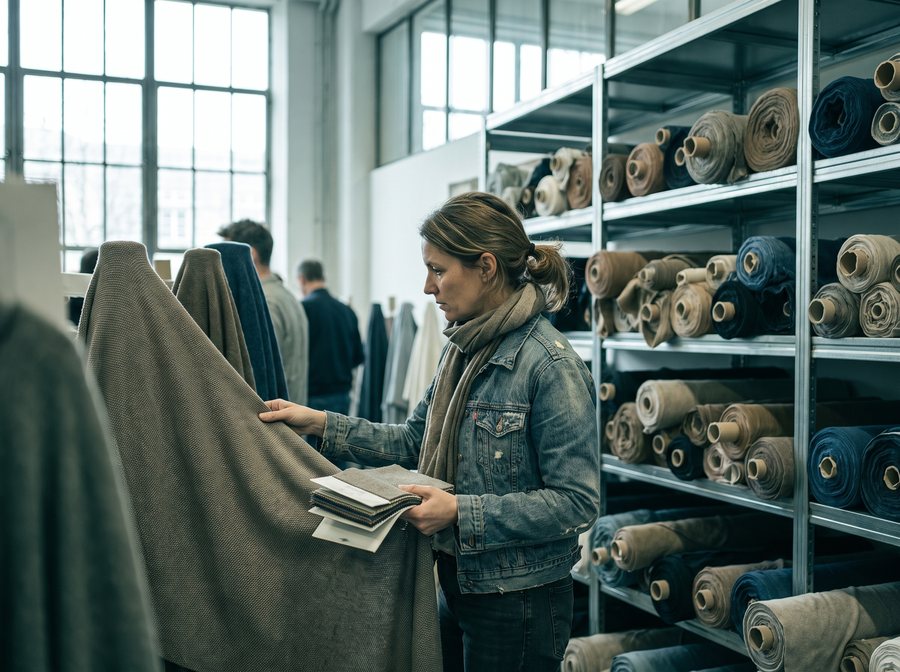
Fabric comes first, not last
Most of the decisions people think are design decisions are actually fabric decisions. How the garment drapes, what it costs, how many you have to make, how long it takes and whether you can reorder it are all downstream of the cloth.
Pick it early. Pattern and fit work done on the wrong fabric has to be redone.
Where fabric comes from
Mills and converters
Make to order, to spec, with real quality numbers, and can rerun the same fabric later. Minimums are typically several hundred yards per colour per construction and lead times run to weeks. This is where a repeatable product eventually has to live.
Stock and mill-held programmes
Fabric the mill or an agent already holds. No material minimum to meet, available quickly, and reorderable while the programme lasts. The trade is that you choose from what exists.
Jobbers
Buy and resell surplus and overrun lots. Excellent prices, immediate availability, tiny quantities — and no guarantee the same fabric exists next month. Ideal for sampling and first runs, dangerous as the basis of a product you intend to reorder.
Full-package factories
Source the fabric for you and absorb the minimums into the garment price. The simplest route when you have no sourcing bandwidth, at a cost.
What to specify when you ask
- Fibre content and blend
- Construction — jersey, interlock, French terry, twill, poplin, canvas
- Weight in GSM or oz/yd²
- Width, and whether that is cuttable width
- Finish — enzyme wash, brushed, mercerised, water-repellent
- Stretch and recovery, if any
- Shrinkage after the intended care method
- Colour reference, and whether it is stock or to be dyed
A request with these eight things gets you comparable quotes. A request for “a nice mid-weight cotton” does not.
Before you commit
- Get a hanger or header sample and handle it — photographs lie about hand
- Ask for the minimum per colour and the dye-lot minimum, in writing
- Divide the material minimum by your consumption per garment to find your real first-run floor
- Wash-test for shrinkage and colourfastness before the pattern is finalised
- Confirm lead time to in-house at the factory, not ex-mill
- Ask whether it can be rerun, and at what minimum
- Approve a lab dip or strike-off for every colour
The reorder trap
The single most common fabric mistake is building a hero product on a jobber lot. The style sells, you go back for more, and the fabric is gone. If a product is meant to last, identify a mill-sourced equivalent before you need it — not after.
Budget for sample fabric
Sampling needs fabric too, and mills often have a minimum purchase even for sample yardage. It is a real line in the development budget and it surprises people every time.
Book a free discovery call and get a straight answer on your specific product.