Guide
Knit vs Woven: What It Changes
The most fundamental fabric decision there is. It changes the pattern, the factory, the machines, the cost and the fit — and it is not a decision you can reverse late.
The structural difference
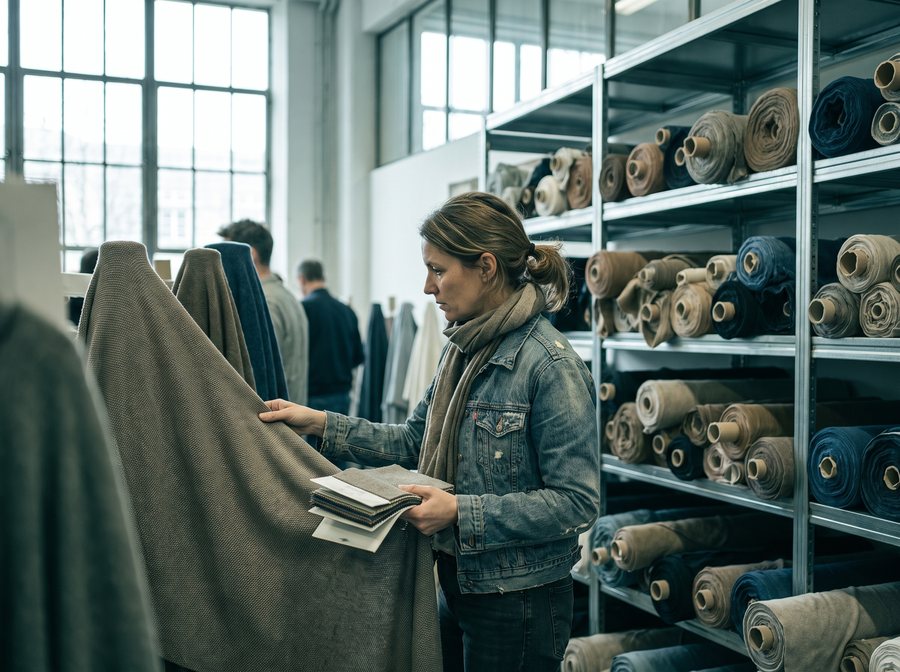
Woven fabric is two sets of yarns crossing at right angles — warp and weft. It is dimensionally stable and has almost no stretch except on the bias. Knit fabric is a single yarn looped through itself, so it stretches in every direction and recovers.
Everything downstream follows from that one difference.
What changes for the pattern
Woven patterns need ease built in, because the fabric will not give. Knit patterns often use negative ease and rely on the fabric to stretch over the body. A pattern drafted for one is not adaptable to the other by scaling — it is a different pattern.
What changes at the factory
- Different machines: knits are largely overlock and coverstitch; wovens are lockstitch, with seam finishing to stop fraying
- Different operator skills — many factories do one well and the other badly
- Different cutting: knits relax and can distort, so they are spread and allowed to rest before cutting
- Different finishing and pressing
- Different interlining and stabilisation needs
This is why “do you specialise in knits or wovens” is one of the first questions to ask a factory. A knit shop making your shirting is not going to end well, and the quote will not warn you.
What changes for cost
Knits are generally faster to sew — fewer operations, less seam finishing — so labour is often lower. Wovens carry more operations: seam finishing, interlining, pressing, more precise matching. Against that, knits are less forgiving of fit errors because the fabric moves.
What changes for quality control
- Knits: measurement is harder because the fabric relaxes — measure consistently, flat and unstretched, and say so on the spec
- Knits: shrinkage and torque (seams twisting after wash) are the main failure modes
- Wovens: grain direction, pattern matching and seam puckering are what to watch
- Wovens: fabric faults are more visible and harder to hide
Choosing
- Does the garment need to move with the body, or hold a shape?
- Is the silhouette structured, or soft?
- What does the category expect — tees and sweats are knit; shirting, denim and tailoring are woven
- Which do your shortlisted factories actually specialise in?
- Which suits the fit tolerance you can live with — knits forgive sizing, wovens do not
The practical warning
Do not change between knit and woven after pattern work has started. It is not an adjustment, it is a restart — new pattern, new sampling, often a new factory. Decide it at product definition, before anything is drafted.
Book a free discovery call and get a straight answer on your specific product.