Guide
AQL Inspection Explained
AQL is how apparel inspection works: a statistical sample, not every garment. Understanding what the number actually means is the difference between a defensible rejection and an argument.
What AQL means
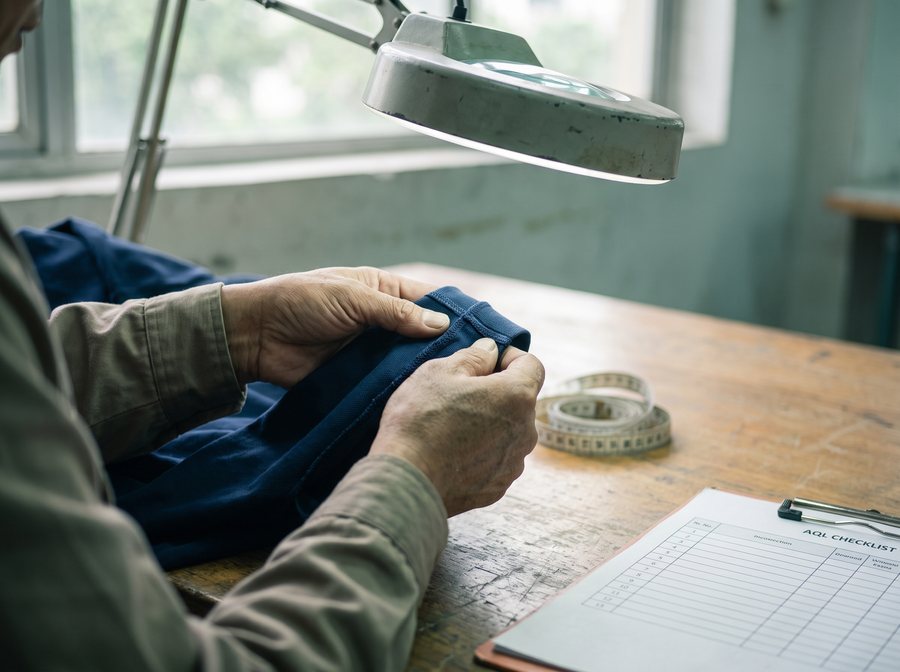
Acceptable Quality Limit. It defines the maximum defect rate a buyer is willing to accept in a shipment, and it drives a sampling plan: how many garments to pull from the order, and how many defects in that sample trigger a rejection.
Inspectors do not check every unit. They check a defined random sample and infer the state of the whole batch from it.
The thing almost everyone gets wrong
AQL 2.5 does not mean “2.5% of my order is allowed to be faulty”. It means the sampling plan is calibrated so that batches whose true defect rate exceeds 2.5% are rejected with a defined statistical confidence. It is a decision rule about the batch, not an allowance you have granted.
The three defect classes
- Critical — zero tolerance. Unsafe, non-compliant, or unsellable in any condition: wrong fabric or colour, open seams or holes, missing care/content labelling, a safety failure.
- Major — commonly AQL 2.5. Affects appearance, fit or function enough to cause a return: measurements beyond tolerance, visible shading between panels, broken or skipped stitching, misplaced print, non-functional trims.
- Minor — commonly AQL 4.0. Cosmetic and within commercial tolerance: loose threads, slight puckering inside tolerance, minor pressing marks, small label placement variance.
Critical 0 / major 2.5 / minor 4.0 is the conventional apparel setting. It is a convention, not a law — agree yours in writing before production, because after the fact it is unarguable.
How the sample size is chosen
From the lot size and an inspection level — general level II is the usual default. The lot size and level give a sample size code, and the code plus the AQL gives the sample size and the accept/reject numbers. Your inspector works from the standard tables; you do not need to memorise them, but you should know which level was used.
A higher inspection level means a bigger sample and more confidence, at more cost. Worth paying for on a first run with a new factory.
What a rejection actually means
It does not mean the goods are unsellable. It means the batch failed the agreed decision rule, and the next step — sort, rework, re-inspect, discount, or reject outright — is whatever the production agreement says it is. Which is exactly why that has to be in the agreement.
Making it work for you
- Agree the AQL levels and inspection level in writing before production starts
- Make sure a sealed PP sample and a graded spec with tolerances exist, or there is nothing to inspect against
- Insist the sample is drawn randomly across cartons, sizes and colourways — not hand-picked
- Require measurements across the whole size range, not just the base size
- Tie the balance payment to a passed inspection
- Agree in advance who pays for rework and re-inspection
The limit of AQL
It catches what the sample reveals. It will not catch a problem that develops later — shrinkage on first wash being the classic. For that you need testing before bulk, not inspection after it.
Book a free discovery call and get a straight answer on your specific product.