
Guide
What Is Cut-and-Sew Manufacturing?
Cut-and-sew means a garment built from your own pattern and specification, not modified from something the factory already makes. Here is what that involves, what it costs you, and when it is worth it.
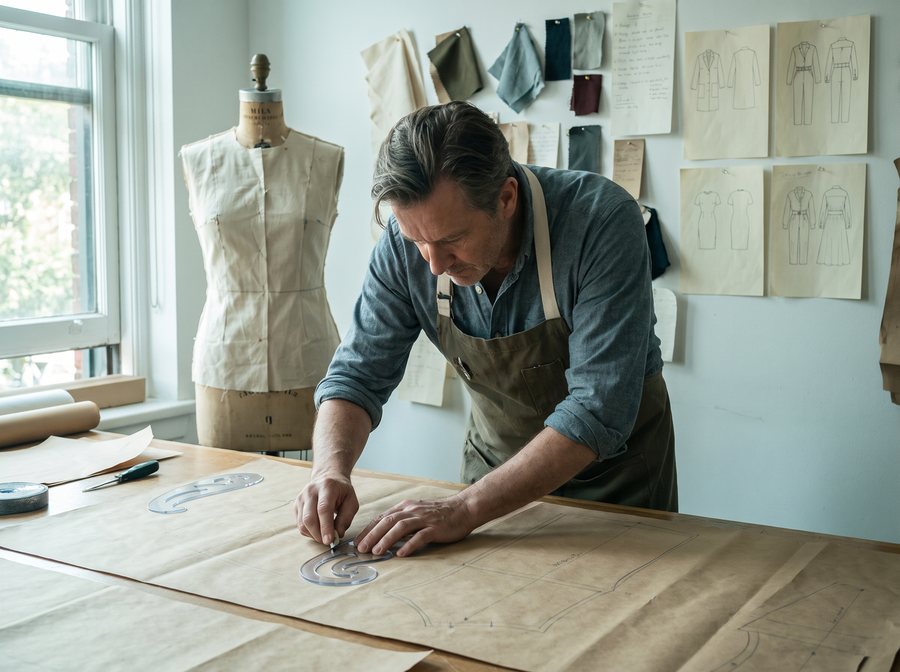
The definition
Cut-and-sew is manufacturing where fabric is cut to your pattern and sewn to your specification. The garment does not exist before you commission it. Contrast this with private or white label, where you are customising or rebranding a product the factory already produces.
The name is literal: the two core operations are cutting panels from a marker laid on fabric, and sewing those panels together. Everything else — pattern, grading, fabric sourcing, finishing, labelling — attaches to those two steps.
What the process requires from you
- A tech pack: flats, construction callouts, graded measurement spec, bill of materials
- A pattern, drafted to your spec and graded across your size range
- Fabric and trims sourced and approved, with lead times that fit the calendar
- Two to four sample rounds: proto, fit, pre-production, top-of-production
- A production agreement covering spec, quantity, price, dates and remedies
None of these are optional. Skipping the tech pack is the single most common reason a cut-and-sew project stalls — factories cannot quote, cut or sew a sketch, and the gaps you leave get filled by whoever is on the floor that day.
What it costs
Expect two separate budgets. Development — patterns, grading, sample fabric at minimum purchase quantities, several sample rounds, shipping — is money spent to find out whether the product works. Production is money spent once you know.
Per-unit cost is also higher than private label at the same quantity, because you are paying for a line to be set up for a garment nobody has made before.
CMT vs full package
Cut-and-sew factories quote one of two ways. CMT (cut, make, trim) means you supply the fabric and trims and pay for labour only. Full package means the factory sources materials as well and quotes a finished garment price.
CMT is cheaper on paper and significantly more work — you are now responsible for fabric arriving on time, in the right quantity, to the right quality. Full package costs more and removes most of that risk.
When cut-and-sew is the right call
- The fit or the construction is the reason someone buys your product
- You need a garment that genuinely does not exist yet
- You are building a block you will reuse across seasons and styles
- You have the time and budget for a real development cycle
When it is not
- You are testing demand and need product in weeks
- Your differentiation is graphics, brand or community rather than the garment
- The development budget would consume the inventory budget
- Your quantities are far below the minimums a cut-and-sew factory needs
Book a free discovery call and get a straight answer on your specific product.