
Guide
What Is Garment Grading?
Grading is how one sample size becomes a whole size run. Done badly it is invisible until the returns arrive — and they will cluster at the ends of the range.
The definition
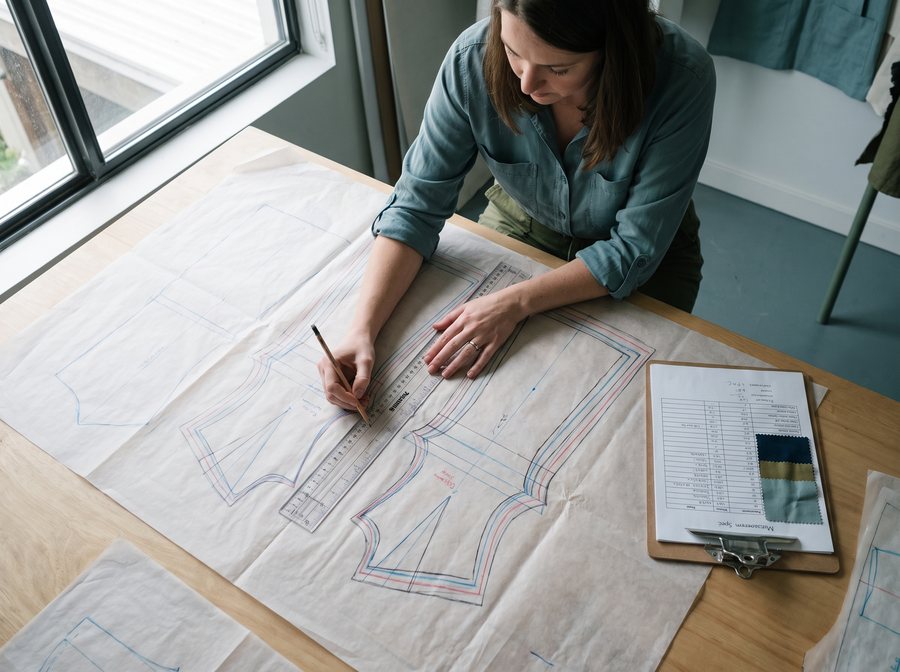
Grading is the systematic increase and decrease of a base pattern to create the other sizes. Each point of measure changes by a defined amount per size — the grade rule — and the garment’s proportions are maintained across the run.
It is not scaling. Enlarging a pattern uniformly makes a size that fits nobody: necks become comically wide, armholes drop, and the proportions of the original fit are destroyed.
Grade rules
A grade rule says how much a dimension changes between consecutive sizes. Chest might grade 5 cm per size while neck width grades 0.6 cm and shoulder 1.2 cm — because bodies do not get bigger evenly, and the garment should not either.
Rules should appear in the tech pack next to the spec, so the factory and your pattern maker are working to the same numbers.
Why fit complaints cluster at the ends
Most brands fit obsessively on the sample size and never try on an XS or a 2XL. If the grade rule is wrong, the base size is perfect and the problem grows with distance from it. The returns data then looks like “the product runs small”, when the real answer is “size XS has the wrong armhole”.
Practical rules of thumb
- Fit the base size first, properly. Grading a bad fit multiplies it.
- Check at least one size above and one below on a real body before bulk.
- Keep the grade consistent across styles that share a block — customers buy across your range.
- Do not grade every dimension. Some — rib height, hem depth, topstitch distance — stay the same at every size.
- Extending a size range beyond two or three sizes from the base usually needs a re-fit, not just more grading.
Extended sizing is not more grading
Going well beyond the base size changes body proportions, not just dimensions. Brands that extend a range by continuing the grade rule produce garments that are technically bigger and genuinely badly fitting. A proper extended range usually needs its own block and its own fit sessions.
Who does it
A pattern maker, or a grader working from the pattern maker’s rules. Many factories will grade for you — which is convenient, and worth checking who owns the result. Graded patterns created at a factory sometimes stay there, which quietly locks you in.
What to ask for
- A graded spec sheet covering every point of measure across every size
- The grade rules written out, not just the resulting numbers
- Graded pattern files in a format you can take elsewhere
- Written confirmation that the patterns and grading are yours
Book a free discovery call and get a straight answer on your specific product.